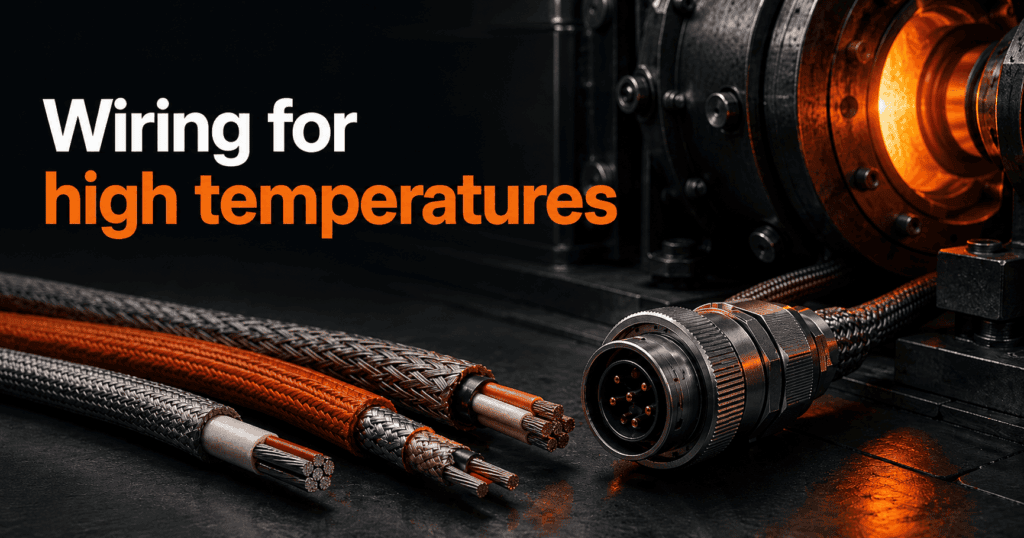
When wiring is used near motors, resistors, ovens, heating systems, industrial machinery, or any other heat source, choosing a cable simply because it has the correct cross-section and number of conductors is not enough.
Temperature affects insulation, casings, seals, connectors, contacts, and even the mechanical behavior of the assembly. A component that functions perfectly at room temperature can harden, deform, lose dielectric capacity, or deteriorate rapidly when it operates continuously above its thermal range.
Therefore, when we talk about connectors and wiring for high temperatures, there isn’t a single family that’s suitable for all cases. An application that operates at 120 °C has very different requirements from one that is permanently located at 200 °C or occasionally exposed to even higher temperatures.
In this article we review what materials and cable families are used in these environments, what types of connectors allow working at high temperatures and, above all, what must be specified before manufacturing a cable assembly intended for demanding thermal conditions.
What does it really mean for a cable to withstand high temperatures?
The temperature indicated in the technical data sheet of a cable defines the conditions within which the manufacturer guarantees the intended properties of the product.
But there is an important detail: the thermal resistance of the assembly does not depend solely on the conductor.
A cable or harness involves different elements:
- conducting;
- primary isolation;
- outer cover;
- screen, if it exists;
- connectors;
- contacts;
- retainers;
- stamps;
- heat shrink tubing;
- protective covers;
- identification elements;
- fastening materials;
They must all be compatible with the expected temperature.
For example, using a cable rated for 200°C connected through a housing designed to work up to 105°C does not make the assembly suitable for 200°C wiring.
The actual thermal limit of the assembly is normally determined by the element with the lowest permissible temperature.
Engineering note: For high-temperature harnesses, simply checking the cable’s datasheet is insufficient. You must verify the permissible temperature of all components within the hot zone, including connectors, contacts, gaskets, sheaths, and accessories.
Continuous temperature and point temperature are not the same
Another common mistake is to work only with the maximum temperature indicated for an application.
We must distinguish between:
Continuous operating temperature: temperature at which the assembly must remain for hundreds or thousands of hours of service.
Temperature spikes: higher temperatures that occur during limited periods due to certain phases of the process or machine operation.
Ambient temperature: the temperature surrounding the cable.
Conductor heating: additional temperature increase caused by the electric current flowing through it.
This last point is especially important in power lines.
If the ambient temperature of a machine reaches 120 °C, the conductor does not necessarily have to be at 120 °C. The current it carries can produce additional heating.
Therefore, the thermal specification must consider the actual temperature that the component can reach and not just the ambient temperature of the installation.
What happens when insulation operates above its nominal temperature?
Exceeding a few degrees occasionally does not necessarily mean that the cable will fail immediately.
The problem is accelerated aging.
Excessive heat exposure beyond what is expected can cause:
- hardening of the insulation;
- loss of flexibility;
- appearance of cracks;
- deformation of the cover;
- reduction of dielectric properties;
- degradation of the seals;
- contact oxidation;
- increased electrical resistance;
- loss of terminal retention force;
- reduction of the useful life of the assembly;
In applications with vibrations, the problem can be exacerbated. Insulation that has lost flexibility due to heat will withstand repetitive movements less well, increasing the risk of breakage near terminals and fixing points.
That’s why temperature should not be analyzed in isolation: heat, vibration, movement, chemicals and humidity often act simultaneously in the most demanding industrial environments.
PVC: suitable for many applications, but not for extreme heat
PVC is one of the most widely used insulation and sheathing materials in industrial cabling due to its balance between cost, electrical performance and ease of manufacture.
However, when the temperature rises considerably, it ceases to be the first option.
There are different formulations and thermal ratings available, so you should always consult the specific technical data sheet. As you approach high continuous operating temperatures, it is usually necessary to switch to insulation families specifically designed to withstand heat.
This means we should not replace one cable with another simply by maintaining the cross-section, number of paths and nominal voltage.
The insulation material becomes a critical specification.
Silicone: high temperature and great flexibility
Silicone insulation is one of the most common solutions when you need to combine high temperature with flexibility.
Depending on the specific construction, there are silicone cables designed to work at around 150–200 °C.
Among its main advantages we find:
- good resistance to high temperatures;
- excellent flexibility;
- good performance across a wide thermal range;
- ease for applications where the cable needs to be bent or moved.
It is frequently found in:
- thermal machinery;
- industrial equipment;
- lightning;
- professional appliances;
- ovens and heating systems;
- certain medical applications;
- indoor connections near heat sources.
Its main limitation is mechanical: some silicone formulations can be more sensitive to cutting or abrasion than other materials.
When there is continuous friction with sheet metal, metal edges or moving parts, it may be necessary to add suitable external protection.
Design decision: High temperature doesn’t simply mean selecting insulation that can withstand higher temperatures. If the cable passes through an area subject to abrasion, vibration, or chemicals, those requirements must be evaluated at the same level as temperature.
FEP: temperature, chemical resistance and contained dimensions
FEP is a fluoropolymer used in applications where, in addition to withstanding high temperatures, good resistance to oils, chemicals or demanding industrial environments is needed.
There are FEP cable constructions designed to work at around 200 °C, although the exact value always depends on the specific reference and the manufacturer’s specifications.
Another advantage is that it allows for the manufacture of relatively thin cables while maintaining good electrical properties. This can be especially useful when space is limited within machinery, control panels, or equipment.
Due to its characteristics, it is often found in instrumentation, automation, industrial equipment and applications where high temperature and chemical exposure coincide.
PTFE: a reference for high-temperature applications
PTFE is one of the most widely used materials when thermal requirements are high. It stands out for its heat resistance, good electrical properties, and resistance to numerous chemical agents.
Depending on the construction, there are cables and components with PTFE prepared to work in ranges close to 250–260 °C.
For this reason, this type of insulation is frequently found in demanding industrial applications, instrumentation, testing systems, equipment near motors, and certain projects in the aerospace or energy sectors.
However, simply stating “PTFE cable” in a specification is not enough. Aspects such as cross-section, conductor type, voltage, required flexibility, and environmental mechanical conditions must also be defined.
When the temperature exceeds 250 °C
Beyond certain temperature levels, conventional solutions cease to be sufficient and it becomes necessary to resort to constructions specifically developed for extreme temperatures.
There are special cables designed to operate at around 300 °C and even higher in very specific applications. In these cases, combinations of fluoropolymers, fiberglass, mineral materials, or conductors with specific treatments are typically used.
Here, the wiring design must be approached as a complete system. It’s not just a matter of replacing the insulation with one that can withstand higher temperatures, but also of verifying that connectors, terminals, protective devices, and auxiliary components maintain their performance.
Indicative comparison of materials
| Materials | Approximate temperature* | Characteristics |
| PVC | Moderate temperatures | Economical and common in industrial cabling |
| Silicone | Up to approx. 150–200 °C | Highly flexible and heat resistant |
| FEP | Up to approx. 200 °C | Good thermal, chemical and electrical resistance |
| PTFE | Up to approx. 250–260 °C | High thermal and chemical resistance |
| Special materials | 300 °C or higher | For extreme applications and processes |
*These values are for guidance only. The maximum temperature should always be checked in the technical data sheet for each product.
What about the connectors?
In many high-temperature applications, the real limit of the assembly is not in the cable, but in the connector.
A cable may be designed to operate at 200°C and be connected to a housing, gasket, or retainer with a considerably lower maximum temperature. In that case, the connector will determine the maximum operating conditions of the assembly.
In industrial applications, specific connector families can be found for temperature ranges of approximately 125–150 °C. When temperatures increase, high-performance connectors are typically used, especially circular families with metal housings and internal materials designed to better withstand heat.
For temperatures above 200 °C there are much more specialized solutions intended for sectors such as energy, aerospace, industrial furnaces, testing or machinery subjected to extreme conditions.
The important thing is not simply to look for the connector that supports the most degrees, but to select a family compatible with the actual conditions of the project.
Terminals and contacts: another critical point
Electrical contacts can also become a weak point when the temperature increases.
Heat can affect the coating, contact resistance, and mechanical stability of the connection. Therefore, depending on the application, conductors and terminals with specific treatments, such as tinned or nickel-plated copper, may be used.
The quality of the crimping is also of particular importance. A poor connection can increase electrical resistance and generate additional heat precisely in the terminal area.
Engineering note: In a high-temperature application, a poor connection can not only cause a voltage drop. The increased resistance can generate even more heat and accelerate the degradation of the assembly.
Don’t forget about covers, heat shrink tubing, and protective cases.
Another common mistake is correctly selecting the cable and connector, but then using auxiliary elements that cannot withstand the same temperature.
Heat shrink tubing, sleeves, labels, cable ties, gaskets or fastening systems are also part of the harness and must be compatible with the work environment.
For example, an assembly prepared for 200 °C may no longer meet its specification if the heat shrink tubing used is only designed for much lower temperatures.
For this reason, in high-temperature cabling, all materials located within the hot zone must be checked.
Not all wiring has to withstand the same temperature.
In many machines, the temperature is not uniform throughout the harness.
There may be an area very close to the motor, heating element or oven where the temperature is high and another part of the wiring located a few meters away where the conditions are much less demanding.
Identifying these areas allows special materials to be used only where needed. This reduces the cost, weight, and rigidity of the assembly without compromising its performance.
Oversizing the entire harness “for safety” isn’t always the best solution. The important thing is to understand the conditions of each section and select the appropriate materials.
What should be defined before manufacturing
Before manufacturing wiring intended for high temperatures, it’s essential to know, at a minimum, the maximum continuous temperature and whether there will be temperature spikes. The current flowing through the conductors must also be considered, as it can cause additional heating.
In addition, it’s important to consider whether vibrations, movement, humidity, chemicals, or abrasion will be present. These conditions can completely change the choice of cable, connector, or protection that is most suitable.
Finally, it must be verified that all elements of the assembly — cable, connector, terminals, seals and protections — are compatible with each other.
Quick checklist
- Continuous temperature and defined thermal peaks.
- Cable and insulation suitable for that temperature.
- Compatible connectors and contacts.
- Sleeves and heat shrink tubing with the correct thermal range.
- Maximum current of the conductor tested.
- Vibration, chemicals and abrasion considered where applicable.
The weakest component marks the limit.
A harness can use a cable rated for 200°C, a connector rated for 150°C, and a heat-shrink tube that can withstand even less.
In that case, the entire assembly cannot be considered suitable for working at 200 °C.
Therefore, the selection of connectors and wiring for high temperatures must be done considering the complete interconnection system and not each component independently.
In demanding industrial applications, correctly defining the operating conditions before manufacturing allows you to avoid premature failures, reduce unnecessary costs, and achieve cabling that is truly adapted to the environment in which it will work.
Do you need to manufacture cabling for high-temperature environments? At JM Cableados, we analyze the assembly characteristics and application conditions to manufacture cabling solutions tailored to each project. Contact us.