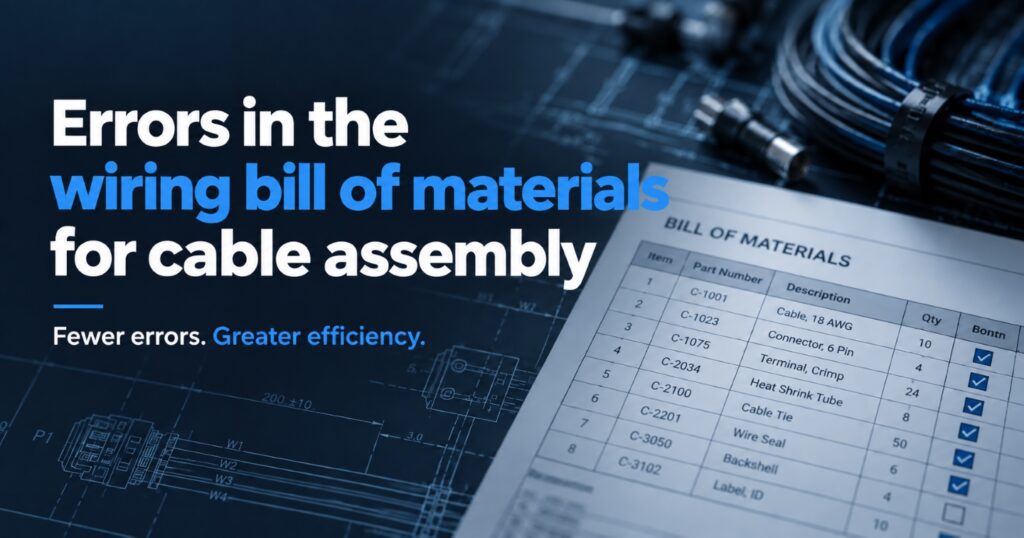
A poorly prepared bill of materials is not a documentation problem. It is a production problem.
When the bill of materials for a cable assembly reaches the manufacturer with incomplete part numbers, unspecified cross-sections or connectors identified only by their trade name, the process comes to a halt. Someone has to call, ask questions, wait for an answer and start again. In the best-case scenario, that costs days. In the worst case, it results in units being manufactured with the wrong component and having to be reworked.
The bill of materials for a custom cable assembly is not a shopping list. It is the document that defines exactly what is going to be manufactured. And when it contains errors, those errors are manufactured too.
In this article, we review the most common mistakes we see at JM Cableados when receiving customers’ bills of materials, the consequences of each one and how to avoid them.
What a bill of materials for a custom cable assembly should include
Before discussing mistakes, it is important to be clear about what a correct bill of materials looks like in the context of industrial cable assemblies.
A cable assembly bill of materials should identify, for each component in the assembly:
Manufacturer part number: the complete and exact part number, not the trade name or an approximate description
Manufacturer or brand: because the same generic designation may refer to incompatible components from different manufacturers
Quantity per product unit: how many units of that component each harness contains
Unit of measure: metres for cable, units for terminals and connectors
Technical description: sufficient to identify the component if the part number is unavailable or has changed
Revision or version: to identify which design version the list was issued against
A bill of materials containing all of this allows manufacturing without ambiguity. If any of these points are missing, it generates queries, delays or errors.
Mistake 1: Specifying the cable only by cross-section without indicating the insulation type
“Red 0.75 mm² cable” is not a cable specification. It is a description that may correspond to dozens of different part numbers with completely different insulation types, operating temperatures, flexibility levels and certifications.
What uniquely defines a cable is the combination of:
Conductor cross-section: in mm² or AWG
Insulation type: PVC, LSZH, silicone, PTFE, polyurethane
Maximum operating temperature: +70 °C, +105 °C, +150 °C, +200 °C
Applicable UL standard: UL 1007, UL 1015, UL 3266, UL 3321, among others
Flexibility: rigid, flexible or highly flexible cable for drag chains
Colour: according to the drawing’s colour code
Using a PVC-insulated cable in an application that requires silicone may seem like a minor detail in the bill of materials. It is not when the harness fails after only a few hours installed next to a heat source.
Technical note: The maximum operating temperature is not the peak temperature the cable can withstand, but the temperature at which it can operate continuously without the insulation degrading. A standard PVC cable can withstand +70 °C continuously. In environments with frequent thermal cycles or close proximity to hot components, that figure is easily reached.
Mistake 2: Lengths without tolerances or termination allowance
Lengths in a cable assembly bill of materials must be manufacturable lengths, not theoretical routing lengths within the equipment.
There are three factors that most lists fail to take into account:
Termination allowance: each end of the conductor requires additional length for stripping and crimping or soldering. Depending on the type of terminal, this allowance may be 5 to 20 mm per end. On a conductor with two terminations, that means up to 40 mm that is not included in the routing length.
Bend radius: a route that measures 300 mm on the drawing may require 350 mm of cable when the harness passes around corners with a real bend radius. Rigid cables require more allowance than flexible ones.
Manufacturing tolerance: an exact length with no tolerance is a specification that no manufacturer can guarantee 100%. The usual approach is to indicate the nominal length with a tolerance: ±5 mm for short lengths, ±10 mm or ±2% for longer lengths.
A bill of materials that states “branch A: 300 mm” with no further information leaves it up to the manufacturer to decide how to interpret that figure. If the manufacturer’s criterion does not match the designer’s, the harness may arrive too short or with excess cable that does not fit in the equipment.
Mistake 3: Bill of materials without versioning or change control
A bill of materials without a version number is a list without history. And a list without history is a permanent source of ambiguity: which design version was used to manufacture the last order? Is the connector change agreed by email reflected in the document? Is the list held by the supplier the same as the one held by the engineering department?
Version control does not need to be complex. These three elements are enough:
Revision number: Rev. A, Rev. B, Rev. 1, Rev. 2 — any system is valid as long as it is applied consistently
Issue date: to know when each revision was issued
Change description: one line explaining what changed compared with the previous version
Without this, every new order is an opportunity for the manufacturer to build from an earlier version without realising it. And when an issue arises, there is no way to determine whether the problem was in the design, the bill of materials or the manufacturing process.
Mistake 4: Mixing component part numbers with assembly part numbers
A cable assembly bill of materials may contain two types of part numbers:
Component part number: the part number of the terminal, housing, cable or any other item purchased individually
Assembly part number: the part number of the finished harness or subassembly, identifying the manufactured product
Mixing them without distinguishing between them creates confusion over what is purchased and what is manufactured. The connector housing is a component that is purchased. The finished harness is an assembly manufactured from those components. They are different levels of the product structure and must be clearly separated.
In projects with several subassemblies — for example, a main harness and several secondary branches assembled on site — this distinction is especially important. Each subassembly must have its own part number and its own component list, rather than being mixed together in a single flat list.
Mistake 5: Not specifying the certifications required for each component
A bill of materials that specifies the correct cable and connector but does not state which certifications those components must have can cause a problem at the worst possible moment: when the equipment is submitted for certification and the cable assembly manufacturer cannot prove that the materials used comply with UL, CE or RoHS requirements.
Certifications are not optional attributes to be added at the end. They are part of the component specification from the outset because they determine which part numbers are valid and which are not.
For each component where applicable, the list should indicate:
UL listing: the specific UL listing the cable must have (UL 1007, UL 1015, UL 3266…)
RoHS compliance: whether the materials must be free from substances restricted under RoHS 3
Connector IP rating: whether the connector must comply with IP67, IP69K or another protection rating
Industry standard: IEC 60601 for medical applications, EN 50121 for railway applications, or any other standard applicable to the final product
Mistake 6: Bill of materials issued before the design is stabilised
Issuing a bill of materials during the preliminary design stage and using it to request a quotation is fine. Using it to request manufacturing before the design has been finalised is a mistake that often becomes expensive.
Design changes during manufacturing involve costs that go far beyond the price of the changed material:
Material already cut or crimped that cannot be reused
Partially wasted manufacturing time
Delivery delays
Possible incompatibility between an already manufactured subassembly and the changed component
The practical rule is simple: a bill of materials should only be released for manufacturing when the design is sufficiently stable for the likelihood of changes to be low. If there are doubts about any component, it is better to resolve them before manufacturing rather than during it.
Checklist: bill of materials ready for manufacturing
Before sending the list to the manufacturer, check that it meets the following requirements:
| Item | Checked |
| Housing and terminal referenced separately for each connector | Yes / No |
| Cable specified with cross-section, insulation, temperature and UL standard | Yes / No |
| Lengths include tolerance and termination allowance | Yes / No |
| List identified with revision number and issue date | Yes / No |
| Component part numbers and assembly part numbers clearly separated | Yes / No |
| Required certifications specified for each component | Yes / No |
| Design stabilised before release for manufacturing | Yes / No |
A bill of materials that passes this checklist reaches the manufacturer ready for production. One that does not will generate questions — and questions cost time.
What you should be clear about before issuing a cable assembly bill of materials
Are all component part numbers complete and verified against the manufacturer’s catalogue?
Do the lengths include termination allowances and manufacturing tolerances?
Does the list have a revision number, and is it the same version held by the engineering department?
Are the required certifications specified for each component where applicable?
Is the design sufficiently finalised to prevent the list from changing during manufacturing?
Once these questions have been answered, the bill of materials stops being a source of problems and becomes what it should be: the document that enables the product to be manufactured correctly the first time.
Do you have questions about the bill of materials for your cable assembly? At JM Cableados, we review your list before preparing a quotation and point out any issues that could cause problems during manufacturing. At no additional cost and with no obligation. Contact us.