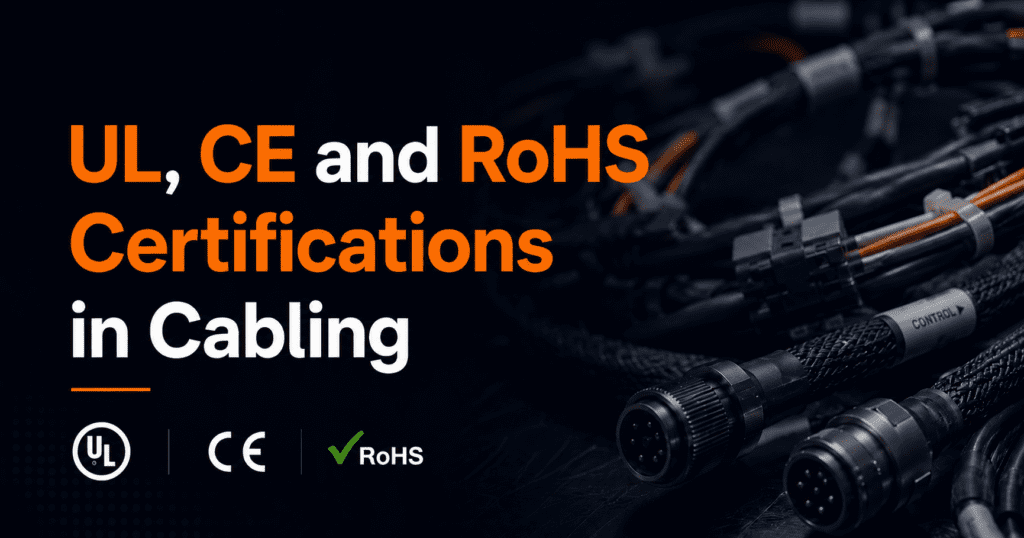
Three acronyms. One very specific problem. When a wiring project crosses borders — or simply reaches a demanding customer — questions about certifications always come up at the worst moment: when the product is already designed.
UL, CE and RoHS are frequently mentioned together, but they are not the same thing and they don’t work the same way. Confusing them has real consequences: homologation delays, customs rejections, audit non-conformities or, in the worst case, having to redesign with production already underway.
In this article we explain what each certification means, how they differ, and how they affect the design and manufacturing of custom wiring.
Three acronyms, three completely different logics
Before going into detail, it’s worth being clear on the starting point:
- CE is a declaration of conformity by the manufacturer with European directives. In most cases, no external body certifies it. The manufacturer declares that the product complies.
- UL is a certification issued by a third party — Underwriters Laboratories — involving physical testing and periodic production audits. It is the dominant system in the North American market.
- RoHS does not certify electrical performance or safety. It restricts which materials can be used in the manufacture of the product, for environmental reasons.
They are complementary, not equivalent. A wiring assembly can carry all three, just one, or none, depending on the target market and the application.
CE marking: manufacturer’s declaration, not an external seal
CE marking is mandatory for placing certain products on the market in the European Economic Area. In industrial wiring, the most common directives are the Low Voltage Directive (LVD) and the Electromagnetic Compatibility Directive (EMC).
What’s worth being clear about: CE marking is not granted by any external body in most cases. It is a self-declaration by the manufacturer. The manufacturer declares, under their own responsibility, that the product meets the essential requirements of the applicable directives, and backs this up with a technical file that must be available in the event of an inspection.
In practice, for custom wiring this means:
- Identifying which directives apply to the specific product
- Carrying out or commissioning the technical tests needed to demonstrate conformity
- Drawing up the Declaration of Conformity and keeping the technical file up to date
Engineering note: CE marking does not guarantee that the product has passed any external testing. It guarantees that the manufacturer has declared conformity. In the event of an incident or audit, the strength of the technical file is what makes the difference. At JM Cableados we prepare that documentation as part of the manufacturing process, not as an afterthought.
UL certification: real testing, periodic audits
UL is the dominant certification system in the US and Canada. If the product is going to that market, or if the end customer requires it as purchasing policy, UL certification can be a non-negotiable requirement.
Unlike CE marking, UL certification involves:
- Physical testing carried out in laboratories accredited by Underwriters Laboratories
- Periodic audits of the production line
- Authorization to use the UL symbol on the product and its packaging
For wiring, the most common listings are UL 758 (appliance wiring), UL 1581 (reference for electrical cables) and UL 62 (flexible cables). The applicable listing depends on the type of product and the specific application.
| Criterion | CE Marking | UL Certification |
|---|---|---|
| Main scope | Europe / EEA | USA / Canada |
| Who certifies | Manufacturer self-declaration | Third party (Underwriters Laboratories) |
| External testing | Optional in most cases | Mandatory |
| Production audit | Not usually mandatory | Periodic |
| Renewal | Does not expire if product doesn’t change | Requires ongoing follow-up |
Workshop reflection: UL certification applies to the cable as a product, not just the materials. If a harness is manufactured with UL-certified cable but the cutting, crimping or termination processes are not controlled in accordance with UL requirements, the assembly may lose the coverage of the original listing. It’s a detail that distinguishes a supplier who understands certification from one who merely mentions it.
RoHS: not a safety certification, a materials restriction
RoHS (Restriction of Hazardous Substances) is a European directive that restricts the use of certain hazardous substances in electrical and electronic equipment. The current version is RoHS 3 (Directive 2015/863/EU), which includes ten restricted substances: lead, mercury, cadmium, hexavalent chromium and several phthalates, among others.
What RoHS regulates is not electrical safety. It regulates which materials have been used in manufacturing, with the aim of reducing the environmental impact at the end of the product’s life.
For wiring, the practical implications are:
- The materials of the conductor, insulation and jacket must be free of restricted substances above the established thresholds
- Material suppliers must provide documentation certifying RoHS conformity: declarations and material analyses
- An increasing number of industrial customers require a RoHS declaration as a purchasing requirement, even when the specific product is not formally subject to the directive
Engineering note: In sectors such as medical, aerospace or automotive, RoHS has become a de facto requirement through purchasing policy, regardless of legal obligation. At JM Cableados we systematically request this documentation from our suppliers, which allows us to certify conformity from the start of the project without subsequent delays.
How certifications affect the manufacturing process
Certifications are not a documentation formality at the end of the project. They drive technical decisions from the very beginning.
Material selection: Not all cables or connectors available on the market have the necessary certifications. Using materials with the correct certification from the design stage avoids having to reformulate once production is already underway.
Component traceability: To support a CE declaration or UL certification, the manufacturer needs traceability of the materials used: which cable, from which batch, with which certification, in which end product. This requires controlled purchasing and recording processes.
Delivery documentation: In projects with regulatory requirements, the wiring is delivered with associated documentation: declaration of conformity, material data sheets, RoHS declaration. This is not optional; it is part of the product.
The international materials problem
One of the most common scenarios: the customer designs the product specifying materials they know from their local market, and it turns out that some of those materials don’t have the certification required by the target market.
This is especially common with cables or connectors from Asian manufacturers that have UL certification but not CE, or vice versa. Or with materials that don’t have a RoHS declaration updated to the current version of the directive.
Workshop reflection: The right question is not “does it have a certificate?”. It’s “does it have the right certificate for the target market, in the current version of the regulation, and with verifiable documentation?”. Those are three different conditions that are not always met together. At JM Cableados we work with selected international suppliers precisely to be able to answer that question with guarantees.
What to have clear before ordering certified wiring
Before contacting a manufacturer, having answers to these questions saves time and avoids late revisions:
- What market will the end product be sold in?
- Does the end customer have their own certification requirements beyond legal regulations?
- Does the design specify specific materials or is there flexibility to adapt based on certified availability?
- Is delivery documentation needed: declaration of conformity, RoHS declaration, technical data sheets?
- Are there imported components whose certification needs to be verified?
With that information on the table, the manufacturing process is more efficient, documentation is prepared from the start, and surprises during audits or in the field are drastically reduced.
Do you have a project with UL, CE or RoHS certification requirements? At JM Cableados we work with certified materials for the main international markets and manage the technical delivery documentation. Tell us about your project and we’ll guide you from the specification stage. Contact us.