“Flat cable is dead.” It’s a phrase you often hear in certain technical forums, almost always followed by a recommendation in favour of round cable or a custom harness. The reality, as it almost always is in engineering, is quite a bit more nuanced.
Yes, the classic IDC ribbon cables have been disappearing from many industrial environments. But at the same time, flat flexible cables (FFC and FPC) have become ubiquitous in modern electronics: they’re inside displays, printers, medical devices, compact equipment. This isn’t a case of “obsolete vs modern” — it’s about knowing exactly which problem you’re trying to solve.
In this article we take an unfiltered look at the real advantages of flat cable, its critical limitations, and when it makes sense to choose an alternative.
What are we actually talking about when we say “flat cable”?
Under the umbrella “flat cable” sit three very different families that shouldn’t be confused:
- IDC ribbon cable: the classic ribbon, parallel conductors in a flat jacket, terminated with insulation displacement connectors. This is the one historically associated with interfaces like IDE, SCSI, or internal connections in PLCs.
- FFC (Flat Flexible Cable): a flat flexible ribbon with laminated flat conductors, usually terminated with ZIF connectors. Very common in consumer electronics and compact devices.
- FPC (Flexible Printed Circuit): a printed circuit on a flexible substrate, with etched conductive traces. Used where maximum flexibility and complex routing in very little space are required.
Each one has its own application profile, advantages and limitations. Mixing them up in the conversation is the first source of confusion when evaluating whether flat cable “works” for a project.
The real advantages of flat cable
Let’s start with what flat cable does well:
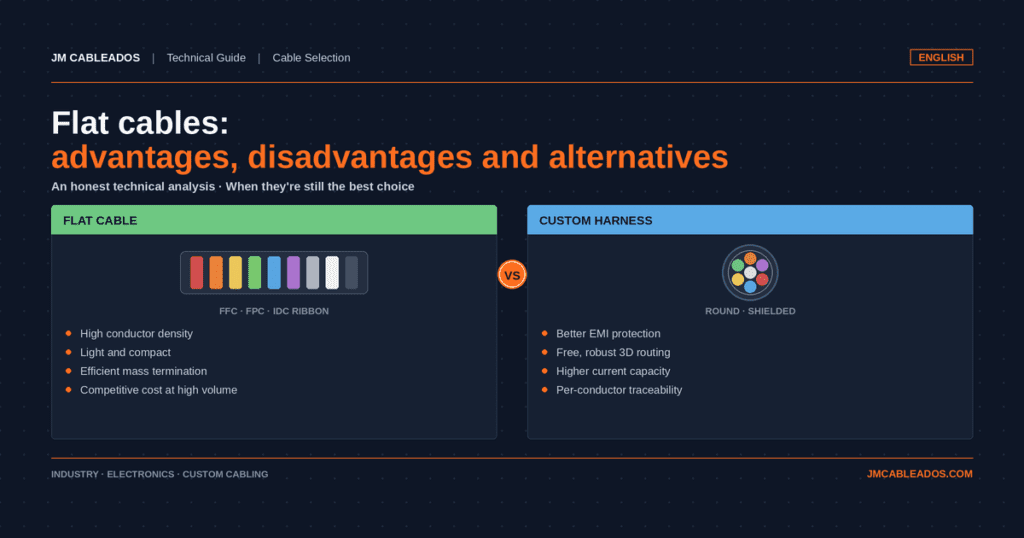
- Density and footprint: many conductors fit within the same thickness, ideal for board-to-board connections or shallow equipment.
- Reduced weight: an FFC weighs a fraction of an equivalent round bundle, which matters in embedded, medical or portable applications.
- Efficient mass termination: with IDC, all conductors are connected in a single press operation. That cuts assembly time in series production.
- Easy visual identification: colour-coded or numbered conductors make wiring and troubleshooting straightforward.
- Flexibility on one axis: FFC/FPC bend repeatedly at very small radii, making them ideal for moving parts (printer heads, hinges, lids).
- Competitive cost at high volume: when the design is standard and production volume is high, flat cable can be more economical than an equivalent round harness.
| Technical fact: A 0.5 mm pitch FFC can pack 30 or more conductors into less than 16 mm of width. Achieving that density with individually shielded round cable is virtually impossible. |
The limitations worth facing head-on
Where flat cable falls short, it falls short clearly. These are the limitations that have the most impact in practice:
- Limited or non-existent shielding: most standard flat ribbons are unshielded. In environments with motors, drives or nearby power signals, they’re an open invitation to EMI noise.
- Reduced current capacity per conductor: the cross-section is usually small. They’re not designed for power.
- Fragile connectors: ZIF and IDC connectors are not designed for heavy vibration or repeated mating cycles.
- Poor mechanical protection: without a thick jacket, they’re vulnerable to abrasion, chemicals, temperature and crushing.
- Complicated 3D routing: flat cable “wants” to run in a line or bend on a single axis. When the path is complex and three-dimensional, it becomes uncomfortable to install and unreliable in the long run.
- Difficult field repair: if one conductor fails, the whole assembly usually has to be replaced.
- Limited traceability: for sectors with regulatory requirements (medical, rail, aerospace), per-conductor control is more complex than with a custom harness.
Quick comparison: flat cable vs round cable vs custom harness
| Criterion | Flat cable | Round cable | Custom harness |
| Shielding / EMI | Limited | Good | Custom |
| Conductor density | Very high | Medium | Custom |
| Current capacity | Low | High | Custom |
| Complex 3D routing | Difficult | Easy | Optimal |
| Mechanical resistance | Low | Medium-high | Custom |
| Cost at high volume | Low | Medium | Medium-high |
| Traceability and certification | Limited | Medium | High |
When to choose flat cable and when not to
It makes sense when:
- The environment is controlled (inside equipment, clean room, technical office).
- Distances are short and the routing is flat.
- There are moving parts that require repeated flexing on a single axis.
- Conductor density is high and space is critical.
- The product is a standard, high-volume design.
Look for an alternative when:
- There’s significant EMI (drives, motors, welding).
- The cable runs outdoors, in weather or in dirty environments.
- High currents or a mix of signal and power are needed.
- There’s constant vibration or frequently handled connections.
- The path is complex and three-dimensional.
- The customer demands per-conductor traceability or specific certification.
Modern substitutes
When flat cable doesn’t fit, the most common options are:
- Custom shielded round cable: the classic answer for EMI, distance and demanding environments.
- Custom harnesses with mixed conductor types: they combine signal, power, ground and communication in a single assembly, with the exact geometry of the route.
- FFC/FPC instead of IDC ribbon: within the “flat” world, FFC has largely replaced the classic ribbon in modern electronics.
- Hybrid solutions: flat cable for internal sections and round harness for the exterior, joined through an intermediate panel.
| Workshop reflection: In our experience, the most expensive mistake isn’t choosing badly between flat and round — it’s failing to revisit the decision when the environment changes. A cable that works perfectly on the test bench can start showing intermittent faults the day it’s installed next to a variable frequency drive. |
The right question
The question isn’t “is flat cable obsolete?”. The question is “what problem am I solving, in what environment, for how long, and to what standards?”. With that information, the choice between flat cable, round cable or custom harness becomes much clearer, and surprises in production or in the field drop dramatically.
| Torn between flat cable, round cable or a custom harness? At JM Cableados we analyse your case and propose the solution that best fits your environment, your volume and your technical requirements. No shortcuts, no surprises in production. Get in touch and we’ll help you make the right call. |