Ordering a custom cable assembly seems straightforward. You call a supplier, describe what you need, and a few days later the harness arrives at your facility. Until it doesn’t fit. Or fails. Or doesn’t meet the required standard. Or arrives in the wrong conductor size.
The mistake is almost never in the manufacturing. It’s in the specification. And the specification is almost always written by someone who knows what they need, but doesn’t always know how to communicate it with the level of detail a cable manufacturer requires to get it right.
This guide is designed exactly for that: so that the next time you order a custom harness, the information you provide is enough to receive exactly what you need.
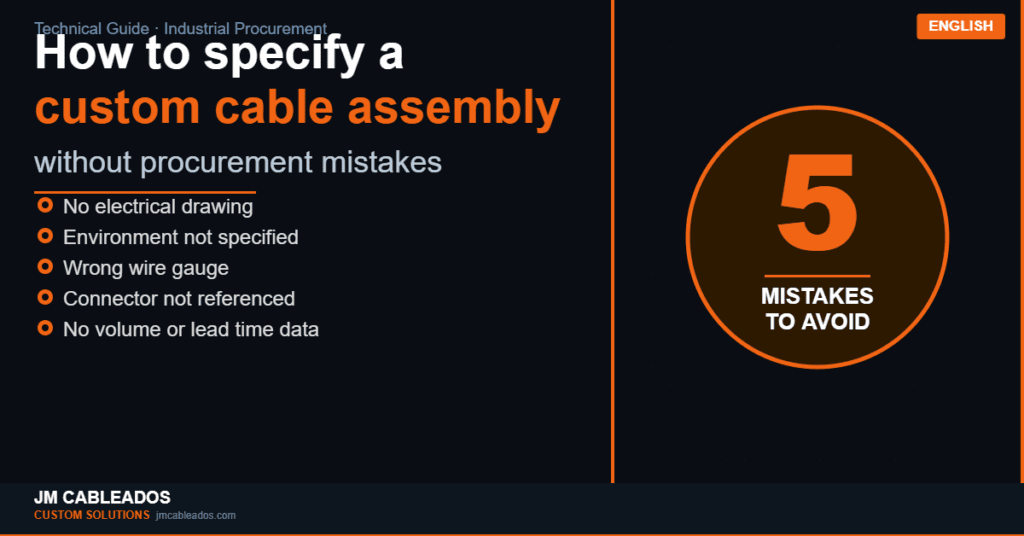
Mistake 1: Ordering a custom cable assembly without an electrical drawing
The most common mistake and the most expensive one. Without an electrical drawing or at least a structured signal list, the manufacturer works on assumptions. And assumptions are paid for in rework.
An electrical drawing does not need to be perfect or in a specific format. KiCad, Altium, PDF, even a hand-drawn sketch with the right information are all valid. What matters is that it contains:
- Number of conductors and their function: signal, power, ground, shielding
- Cross-section of each conductor in AWG or mm²
- Lengths of each branch or sub-assembly
- Connector type at each end with the manufacturer part number
- Connection direction: pin A of connector X goes to pin B of connector Y
| Engineering note: At JM Cableados, when a customer does not have a drawing, we help them build the signal list from the functional specification of their equipment. It is an extra step that prevents a great deal of problems down the line. |
Mistake 2: Not specifying the custom cable assembly operating environment
The cable assembly does not work in a vacuum. It works inside a machine, on a factory floor, in a vehicle or in a medical device. The conditions of that environment determine every single material decision in the harness.
Before requesting a quote, be clear about and communicate:
- Minimum and maximum operating temperature — and whether it is continuous or intermittent
- Presence of oils, solvents, water, dust or chemical agents
- Vibration level and type of movement: static, continuous flex, flex and fold
- Ingress protection requirements: IP67, IP69K or other rating needed?
- Applicable standards: UL, CE, RoHS, IEC, medical, defence, automotive
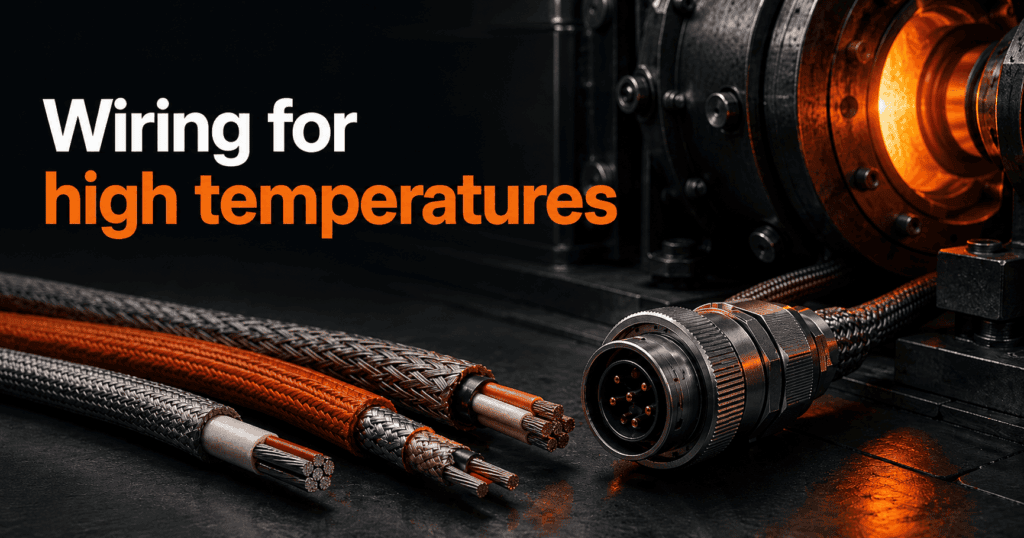
| Technical data: PVC-insulated cable withstands up to +105 °C continuously. If your equipment operates near a heat source or outdoors with wide thermal cycles, you need silicone (+200 °C) or PTFE. The cost per metre changes — but replacing the entire harness once it is already installed in the equipment costs far more. |
Mistake 3: Confusing wire gauge with actual current
‘Give me a thick cable, it is going to carry current.’ This is the most common instruction and the least useful one for a manufacturer. Conductor cross-section must be calculated based on the actual maximum current of the circuit, the branch length, the acceptable voltage drop and the operating temperature.
| Cross-section | Indicative max. current | Typical application |
| AWG 28 / 0.08 mm² | 0.5 A | Sensor signal, data |
| AWG 24 / 0.25 mm² | 2 A | Control, analogue signal |
| AWG 20 / 0.50 mm² | 5 A | Low-power supply |
| AWG 18 / 0.75 mm² | 8 A | Actuators, relays |
| AWG 16 / 1.50 mm² | 13 A | Medium-power supply |
| AWG 14 / 2.50 mm² | 20 A | Small motors, heating |
| Workshop insight: Oversizing the cable unnecessarily increases cost, weight and harness stiffness. Undersizing it generates heat, voltage drop and, in the worst case, fire. Cross-section calculation is one of the first things we review when analysing a new drawing at JM Cableados. |
Mistake 4: Specifying a connector by trade name without the full part number
‘Give me a JST connector’ is not a specification. JST has over 50 connector families with pitches ranging from 0.8 mm to 7.62 mm, currents from 0.5 A to 30 A, and certifications from general grade to IP67. The same applies to Molex, TE Connectivity, Deutsch or Amphenol.
The minimum information to correctly specify a connector:
- Manufacturer and family: e.g. JST JWPF, Molex MX150, Deutsch DT
- Number of positions (ways)
- Full part number for the housing AND the terminals — they are separate components
- Connector orientation: straight, right-angle, panel mount, PCB
- Required certification: IP67, IP69K, UL94V-0, etc.
| Engineering note: If you are unsure about the connector, tell us the operating conditions and we will recommend the most suitable family. We know the JST, Molex, TE, Deutsch and Amphenol catalogues well, and we manufacture with all of them. |
Mistake 5: Not indicating volume or production horizon
Production volume determines the technical solution, the materials, the tooling and the price. Manufacturing 10 units of a complex harness is not the same as manufacturing 5,000. Beyond certain volumes, the investment in automatic crimping tooling and assembly jigs amortises quickly and significantly reduces the unit cost.
Always communicate to the manufacturer:
- Initial quantity of the first order
- Annual forecast or frequency of future orders
- Whether it is a prototype or series production
- Required delivery lead time for the first unit and for series
| Workshop insight: At JM Cableados we have no unreasonable minimum order quantities. We manufacture from a single unit for prototypes to long production runs with recurring delivery. But knowing the horizon allows us to optimise the process and offer you the best possible price from the very first order. |
Checklist: minimum information to order a custom cable assembly
| Parameter | Do you have it? | Impact if missing |
| Electrical drawing or signal list | Yes / No | Risk of wiring error |
| Cross-sections and lengths of each branch | Yes / No | Oversizing or electrical failure |
| Operating temperature and environment | Yes / No | Wrong material, premature failure |
| Full connector part number | Yes / No | Incompatibility with the equipment |
| Ingress protection requirement (IP rating) | Yes / No | Field failure due to moisture or dust |
| Applicable standard (UL, CE, RoHS…) | Yes / No | Equipment certification issues |
| Volume and production horizon | Yes / No | Non-optimised price, incorrect lead times |
| Do you have a cabling project and do not know where to start? At JM Cableados we analyse your requirement, help you specify it correctly and manufacture the exact harness for your application. No unreasonable minimums, fast delivery and a test certificate on every unit. Contact us: info@jmcableados.com |