On some assembly lines, the cabling is prepared at the workstation itself: cutting, stripping, crimping and grouping wires before installing them in the equipment. It is work that is not part of your product, yet it takes up time, space and staff.
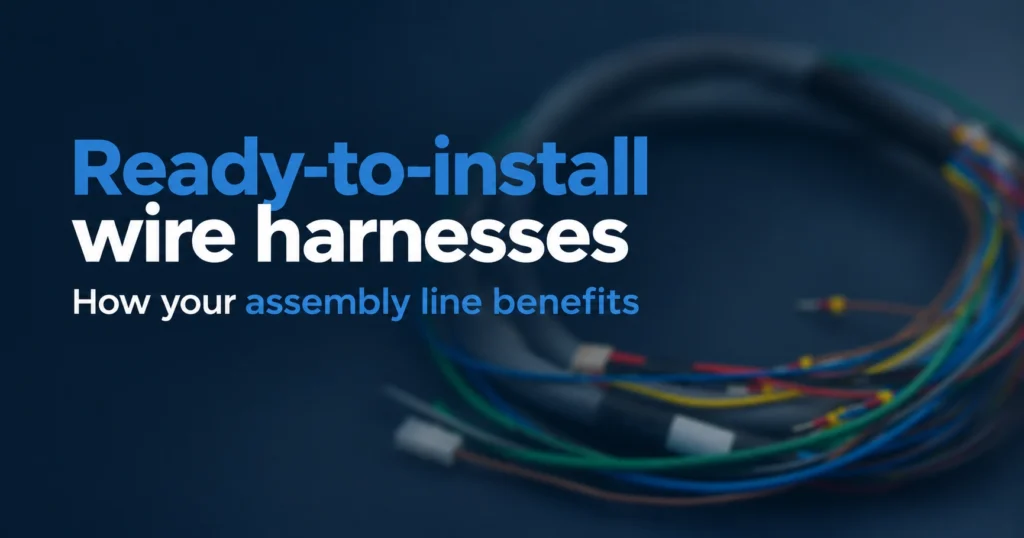
The alternative is to receive the finished harness: wires cut to length, terminals crimped, connectors assembled and branches in place, ready to connect. In this article, we look at exactly what “ready to install” means and what your line gains when the cabling arrives that way.
What it means for a harness to arrive ready to install
A ready-to-install harness is a cable assembly that leaves the manufacturer with all the cabling operations done. All that is left for your line is to fit it and connect it.
In practice, that includes:
- Wires cut and stripped to the length on the drawing, using automatic cutting and stripping machines.
- Terminals crimped or soldered to your specification. In our case, we work with more than 200 terminal references and lead-free soldering for RoHS applications.
- Connectors assembled, with each terminal in its cavity.
- Branches at the dimensions on the drawing, so that each breakout reaches its point in the equipment.
- Control on every order, adapted to the customer’s specification.
The exact scope is set by your drawing: what you define there is what you receive assembled.
What your assembly line gains
Fewer operations per unit. The assembly workstation no longer cuts, strips or crimps. Cabling comes down to fitting the harness and connecting each breakout, and the assembly time for each unit is shortened.
One part number instead of dozens. Instead of managing reels of wire, terminals, housings and protection separately, your warehouse receives one harness with one reference. Purchasing, inventory and procurement become simpler.
Your team, focused on your product. Crimping and soldering require qualified staff and specific training. With the finished harness, your operators spend their time assembling and testing your equipment, which is where they add most value.
Free floor space. With no cutting machines, crimpers or applicators on your line, that space is available for your own production.
More repeatable assembly. When every harness is made from the same drawing with the same automated process, every unit arrives identical. Assembly becomes more predictable and easier to teach to a new operator.
A pace that matches your production. With no minimum order, you can order harnesses at your line’s pace: a prototype, a pre-series or the full series.
Loose wires or a ready-to-install harness: comparison
| Aspect | Preparing the cabling on your line | Receiving the harness ready to install |
|---|---|---|
| Operations at the workstation | Cutting, stripping, crimping, assembling connectors and grouping | Fitting and connecting |
| Stock references | Reels, terminals, housings and protection held separately | One harness part number per unit |
| Machinery and tooling | Crimpers, applicators and soldering stations on site | Provided by the manufacturer |
| Staff | Operators trained in crimping and soldering | Operators focused on assembling your equipment |
| Repeatability | Depends on the workstation and the operator | Same drawing and same process for every unit |
| Certified materials | Procurement and documentation are your responsibility | UL, CE and RoHS materials supplied by the manufacturer |
| Volume | Tied to your line’s capacity | From prototype to series, with no minimum order |
What the manufacturer needs to deliver it ready
A harness only arrives ready to install if the drawing reflects how it fits into your equipment. To quote and manufacture it, gather this information:
- Dimensioned drawing, including the dimensions of each branch
- Connectors and terminals with full part numbers
- Wire type and cross-section for each conductor
- Protection and identification requirements, if any
- Required certifications (UL, CE, RoHS)
- Quantities, lead time and destination
For more detail, see our guide on how to specify a custom cable assembly.
From prototype to series, with the same harness
Ideally, validate the harness with a prototype fitted in your equipment before launching the series. That way you check routing, lengths and connections on the real machine, and any adjustment goes into the drawing before production.
Once validated, the series is made from the same drawing with the same process. Your line receives, with every order, the same harness you approved.
Want to receive your harnesses ready to install?
At JM Cableados, we have been manufacturing custom wire harnesses in Viladecans (Barcelona) since 1987, with UL, CE and RoHS certified materials and no minimum order. Send us your harness drawing and we will get back to you promptly.